Apple's latest top-spec mobile phones are a genuine step up in performance and ability. But the typical high-end user these handsets are aimed at likely won't use a fraction of what the Pros are capable of. They just want the best one
The trouble with the luxury market is that money does not always equate to either taste or technical proficiency. If you’re serious about hypercars, for example, then there’s little point in shipping your Lamborghini Aventador all the way from the Middle East to pose in Kensington traffic.
Now, the new top-spec iPhones may not be the tech equivalent of a Lamborghini (okay, bad example), but the new iPhone 11 Pro and Pro Max are, we’ll state up front, the best iPhones ever. And while they come at a high price, one thing is clear: they’re all about the cameras and the ridiculous things you can do with these three lenses on the rear of each model – things, according to Apple, approaching professional camera ability.
As such, you would think most people going for the Pros will be (rich) creative types looking to squeeze the most out of every photo and video. But no, confusingly, it's more than likely those willing to shell out the premium for the Pros will use them just like their old iPhones (and the vast majority will be existing iOS users), rarely, if ever, delving fully into what the camera can do.
Any Android converts Apple does lure away from Google and the rest will be going for the new standard iPhone 11, as Apple has gone and made it so damn good. Or perhaps they will dip their toes in iOS waters with the still on sale, still very good XR. The Pros are for the Apple faithful. The ones that were always going to upgrade anyway.
A sensible name
The iPhone 11 Pro. That's better. A name you can understand, which is a lot more than can be said for the iPhone XR or XS. The baffling names have been banished and now we get the iPhone Pro and Pro Max, to nestle nicely alongside the Pro iPad, Mac and MacBook siblings. Breathe easy.
That new name also makes clear that Apple feels the Pro and Pro Max are not for those looking for value, but those looking not only for one-upmanship but also iOS punters who are creative types. You know the sort – the kind that like taking lots of video and pictures... okay, actually that's most of us. Well, then they are for the kind that don't mind dropping from £1,049 up to a thumping £1,499 for the Max version with 512GB of internal storage.
Pro, of course, often means better, so it may seem strange that the iPhone 11 Pro has the same processor as the iPhone 11. The vanilla 11 also has most of the new fancy camera abilities, including ultra-wide and night mode. The tangible benefits of the Pros then are the third telephoto camera, an 18-watt charger (settle down, people) and a high-resolution OLED display (and this in a larger 6.5-inch iteration if you plump for Max).
Design
There's the stainless steel frames where the lowly iPhone 11 is made of aluminium. The back of the Pro phones have a textured matte finish on the glass, which makes them less slippy to hold. But you won't feel this anyway as you're going to put a case on a phone that costs a grand and a half, right?
Apple once again is saying its new iPhones have the toughest glass in any smartphone, a claim for which it is releasing no evidence whatsoever, and so must be discounted.
The Pro phones come in muted Apple colours (Space Gray, Silver, Midnight Green) as well as Gold. They are undoubtedly stylish, but somehow look a little po-faced next to the iPhone 11’s breezier pastel options.
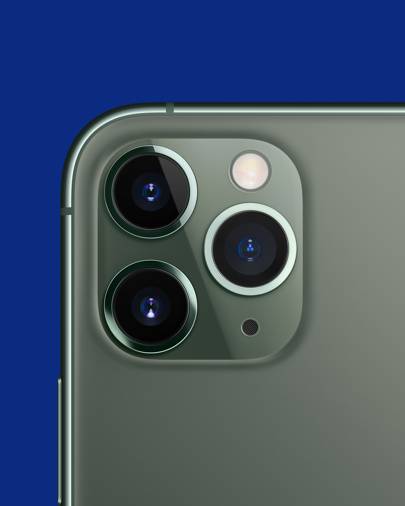
On the rear there has been some nice design trickery to fool you into thinking the three-lens array sticks out less than it actually does. Look closely and you'll see a raised plinth on which the three cameras sit. These then stick out even further from this plinth. It's a neat optical illusion disguising what could have been quite an ugly feature.
That's not to say it looks good, this new camera pack. Some have amusingly compared the trio of lenses to the head of a Philips electric shaver. Mind you, no phone manufacturer has managed to make their massive rear camera arrays look stylish.
Perhaps the biggest difference in the Pros are the sizes. The 11 has a 6.1-in screen, the Pro a smaller 5.8-in screen and the Pro Max that 6.5-in version. The Max is so large and heavy that while it may be lovely to watch video on that 2688x1242 resolution, 458ppi display, and it is, carrying around the phone itself quickly – within days, not weeks – becomes a chore. You want to scream "less pies, more salad!" at the thing.
The smallest of the three, the Pro, is the ideal size, and its 2436x1125 resolution, 458ppi screen is just as sharp and is more colourful than on the iPhone 11. Yes, the smaller size and brightest ever iPhone screen is a killer combo, but it's not all good news.
The wide notch is still there at the top of the screen, and some time ago it started to look behind the times once hole-punch screens came along, as well as displays that dispensed with notches or holes altogether. That familiar wide notch now contains an upgraded selfie camera.
Picture perfection
While the iPhone 11 has two 12MP lenses, wide-angle and a 120° field-of-view ultra-wide, the Pro and Pro Max add in a new telephoto lens to the mix. The wide-angle lens has an f/1.8 aperture, the ultra-wide a f/2.4 aperture and the telephoto an f/2.0 aperture. See! We've lost you already. What do you care about f-stops?! You just want to point the damn phone at something and have machine learning take over and create a masterpiece with no effort on your part.
To its credit Apple is trying to do just this for you, while you sit back and take the credit. Let's cut to the chase and say right now that this Pro set-up is by far the best camera we've seen in a iPhone yet, and the 11 in general is a noticeable and satisfying step up from the previous generation in this department, which is a welcome change from recent iPhone launches.
There are a few zoom options: the normal 1x view, the 0.5x zoom out from the ultra-wide lens (both of these are also on the 11) and the Pro-only 2x zoom courtesy of that telephoto lens. The front camera gets a bump from seven to 12MP, and now has a wide-angle option as well.
All the new iPhones get the new Night Mode, and this is where Apple's phone takes the reins and flatters your compositional skills. Night mode kicks in automatically, taking longer exposures, so you don't have to think about it further than obeying the on-screen instructions that tell you how long you have to hold the phone steady to capture a very impressive low-light shot.
We gave the new Max Pro to one of our professional photographers to try out for a couple of days. He gave the three-lens array in general the thumbs up, saying: "I was most impressed with the longer lens for taking portraits. I always wished I had one of those on my iPhone."
However, our snapper did highlight some limitations of the system: "The key difference between this and a pro camera is the size of the sensor is tiny, so you have no control over depth of field, which is why they have to implement it digitally. The bigger the sensor the more control you have over which parts of the image are out of focus and which are out of focus. Also, only jpeg files come out of the Camera app so there is no flexibility in recovering highlights or shadows or correcting colour. Don't get me wrong, this is great but not professional standard."
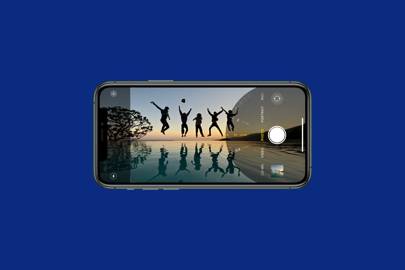
One last point deserving a mention here is the clever camera app UI where taking video or changing options and settings with a swipe of the thumb is much more intuitive than it has any right to be. And one of the best parts is where the black borders either side of the preview camera image dissolve away to transparent to surreptitiously suggest the shot composition if you switched to ultra-wide.






0 Comments